

Team Classification Information
Use the information below to find the correct classification for your team!
B/C Series Team Classification & Division Eligibility
Our Philosophy
At the B/C Series, our goal is to create the most competitive and enjoyable tournament experience possible.
Over the years, the youth baseball landscape has changed dramatically. Today's teams range from elite travel organizations to local community all-star teams. Because these teams are built differently, using a single classification system no longer creates fair competition.
To ensure competitive balance, the B/C Series uses two separate classification systems:
- D1, D2, D3 – For Travel Organizations
- A, B, C – For Community-Based Teams
A team's classification is determined by how the roster is built first, and its competitive level second.
Step 1: Determine Your Team Type
Travel Organization
A team is considered a Travel Organization if it:
- Draws players from more than one school district or recreation program
- Holds open tryouts for players from multiple communities
- Operates as a travel or select baseball organization
- Is not restricted to a single town or school district
Travel organizations compete in the D-Level divisions (D1, D2, D3).
Community Team
A team is considered a Community Team if:
- The roster is made up primarily of players from one school district, one town, or one recreation organization
- The team represents a local community rather than a travel organization
- Players are not recruited from multiple school districts to strengthen the roster
Community teams compete in the A, B, and C divisions.
Travel Organization Classifications
D1 – Elite Travel
D1 is the highest level of travel baseball.
These teams typically:
- Compete against the strongest regional and national competition
- Consistently perform at a high level
- Have experienced players and deep pitching staffs
- Travel extensively throughout the season
Classification: Determined using the DivLevel system and tournament performance.
D2 – Competitive Travel
D2 teams are strong travel organizations that consistently compete at a high level but are not considered elite.
These teams typically:
- Compete successfully in regional tournaments
- Have experienced rosters
- Play competitive schedules
- Focus on advanced player development
Classification: Determined using the DivLevel system and tournament performance.
D3 – Developmental Travel
D3 teams are developing travel organizations.
These teams typically:
- Focus on player development
- Compete primarily in local and regional tournaments
- Are newer travel organizations or lower-level travel teams
- Continue to build experience against similar competition
Classification: Determined using the DivLevel system and tournament performance.
Community Team Classifications
A Division – Advanced Community
A Division is designed for the strongest community-based teams.
These teams typically:
- Represent one community or school district
- Have experienced players
- Compete regularly in tournaments
- Consistently perform well against other community teams
B Division – Intermediate Community
B Division is intended for solid community teams seeking balanced competition.
These teams typically:
- Represent one community or school district
- Have a mix of experienced and developing players
- Focus on player development while remaining competitive
C Division – Developmental Community
C Division is intended for beginner and developmental community teams.
These teams typically:
- Are new to tournament play
- Focus on development and experience
- Represent one community or school district
- Benefit from playing against similarly experienced teams
Division Eligibility
The following chart outlines which divisions each classification may enter.
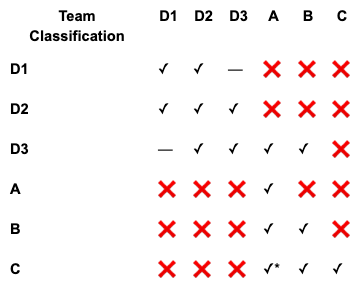
*C teams may choose to "play up" into A competition if they wish, but A teams may not play down into B or C.
Playing Up vs. Playing Down
The B/C Series allows teams to play up in competition but does not allow teams to play down into divisions intended for less experienced teams.
Examples:
- A D3 team may enter an A or B event.
- A D3 team may not enter a C event.
- An A team may choose to play against stronger competition but may not enter a B or C event.
- A B team may play A but may not enter a C event.
- D1 and D2 travel organizations may never compete in A, B, or C community divisions.
Roster Integrity Rules
To protect competitive balance:
- Community teams must primarily consist of players from one school district, one town, or one recreation organization.
- Travel organizations may draw players from multiple communities.
- Teams may not create "all-star" or "super team" rosters solely to compete in lower divisions.
- The B/C Series may request roster information to verify eligibility.
Tournament Director Authority
Competitive balance is more important than labels.
The B/C Series reserves the right to:
- Review any team's classification.
- Move a team to a more appropriate division.
- Deny entry into a division that does not match the team's roster or competitive level.
- Reclassify teams based on tournament results, roster composition, or competitive history.
Our goal is simple:
Every team deserves to compete against teams of similar ability, giving players, coaches, and families the best possible tournament experience.